
CSDH/SCHN Congress 2025: Reframing Togetherness
The Canadian Society for Digital Humanities hosted papers, panels, and digital demonstrations for its annual meeting, at George Brown College as part of the 2025 Congress of the Social Sciences and Humanities from May 30 to June 1.
This year’s meeting critically engaged with the Congress 2025 theme of “Reframing Togetherness.” Togetherness and community are fraught concepts, and we welcomed a variety of projects that think carefully about creative and ethical ways of attending to difference and togetherness within communities and across disciplines. Digital humanities work offers new possibilities for fostering critical forms of difference from ‘traditional’ humanities, and this year we explored the implications of such DH work.
Plenaries
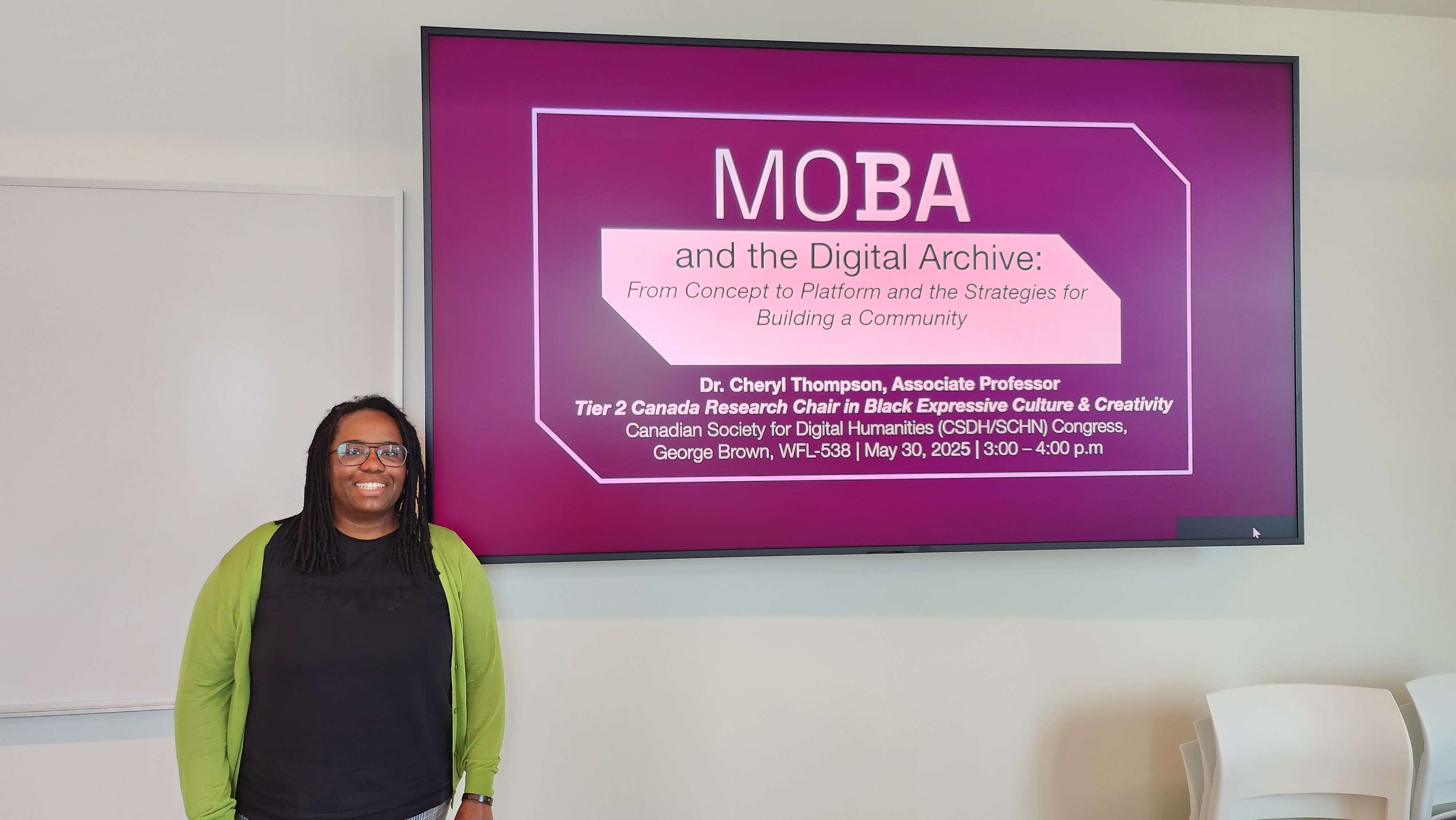
MOBA and the Digital Archive: From Concept to Platform and the Strategies for Building a Community – Cheryl Thompson
Dr. Cheryl Thompson is an Academic, Public Speaker, and Director, Research and Creative Strategy of Mapping Ontario’s Black Archives (MOBA), an Ontario Early Researcher Award, and Social Science Humanities Research Council (SSHRC) funded project. MOBA is reimagining Black archives in the province of Ontario by making Black archival collections accessible and searchable via an open access online platform. She is also Director of Black Creative Lab, an incubator for the curation of public exhibits, speaker events, and YouTube content. She is the author of Uncle: Race, Nostalgia, and the Politics of Loyalty (2021), and Beauty in a Box: Detangling the Roots of Canada’s Black Beauty Culture (2019). Her third book, Canada and the Blackface Atlantic: Performing Slavery, Conflict, and Freedom, 1812-1897, was published in April 2025. Dr. Thompson is a Tier 2 Canada Research Chair (CRC) in Black Expressive Culture and Creativity and an Associate Professor, and in 2021, Dr. Thompson was inducted into the Royal Society of Canada’s College of New Scholars, Artists, and Scientists for her contributions to Black Canadian studies.
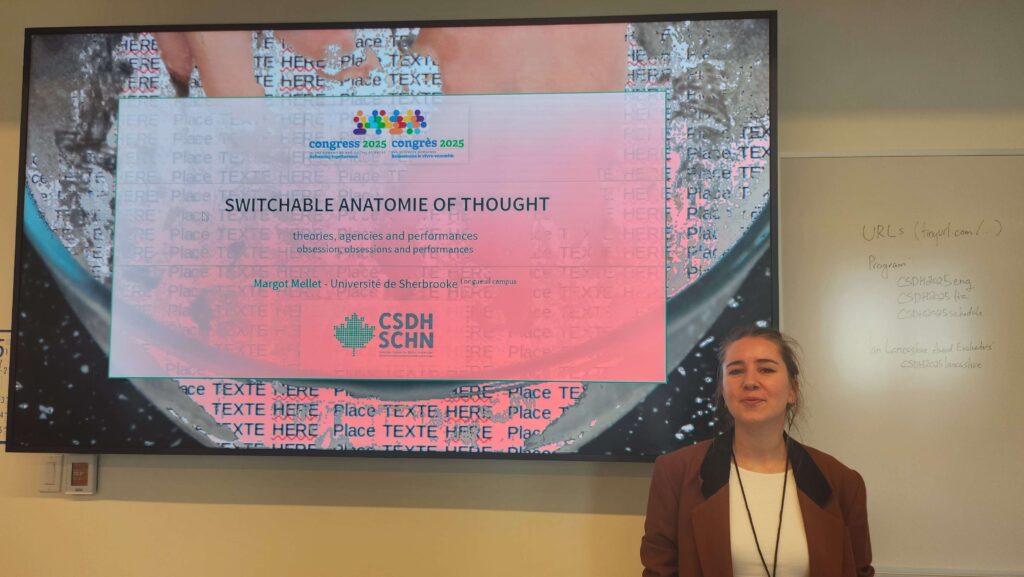
Switchable Anatomie of Thought – Margot Mellet
Margot Mellet is an assistant professor and coordinator of the graduate publishing programs at the Université de Sherbrooke. Her current research focuses on digital culture and publishing, alternatives writing practices in literature, and processes of knowledge production in the humanities and social sciences. Combining research and publishing practices, she is involved in a number of publishing communities : co-editor of the bilingual journal Imaginations: journal of cross-cultural image studies, director of the journal Sens public, and director of the ‘De code et de plomb’ collection at the Presses universitaires de Rouen et du Havre.
Awards
Click through to learn more
Conference Program
9:00 AM
Opening Welcome
In memoriam: Ian Lancashire
10:15-11:45 AM
1A: Society
Togetherness in the Digital Age: A New Framework for Mindful ICT Use
Uthpala Senarathne Tennakoon
Sphering the Circle: Reframing the Formation of YouTube’s “Manosphere” within Performative AI
Eric Ward Joosse
1B: Digital Capitalism
The ‘terms and conditions’ of surveillance capitalism: theorizing agricultural data policy and governance
Sarah-Louise Ruder
Choose Your Poison: Data Colonialism or Company Town?
Frank Onuh; A K M Iftekhar Khalid; Barbara Bordalejo; Daniel O’Donnell
Searching Tranquility over Ceaseless Rush: The Simulation Hypothesis, Digital Capitalism, and Zhuangzi’s Philosophy in Emily St. John Mandel’s The Sea of Tranquility
Zhenyao Quan
1C: Historical DH
How Are We Doing? Canadian Papyrus Collections between Digitization, Accessibility and Sustainability
Victoria Gioia Désirée Landau
Experiments in History: Can Crowd Simulation Predict the Past?
Noa Yaari
Threads of Time: A Digital-Material Gestalt Approach to Historical Inquiry
Vera Zoricic
Building a digital bridge over an interdisciplinary gap: Scaffolding the mathematics of premodern astronomical texts for humanistic research and pedagogy
Pouyan Shahidi Marnani
1:15 PM-2:45 PM
2A: DH Workshops: Pedagogy and Practice
Sustaining a DH Training Ecosystem: Curriculum, Centre, Certificate
Jason Boyd
Connective Links: Building Graduate Student Knowledge, Community, and Capacity in DH
Alexis-Carlota Cochrane
What Can We Learn When We Come Together?: The Canadian Certificate for Digital Humanities / Certificat canadien en Humanités Numériques (cc:DH/HN)
Laura Estill
2B: Pour des implémentations critiques de l’IA en SHS. Peut-on résister au monopole Big Tech?
Marcello Vitali-Rosati; Frédéric Clavert; Servanne Monjour; Nicolas Sauret; Louis-Oliver Brassard; Victor Chaix; Roch Delannay; Giulia Ferretti; Clara Grometto; Alexia Schneider
2C: Games & Play
“This Game Cured My Depression”: Celeste Steam Reviews as Platformized Community Archive of Transformative Play
Andrew Remington Bailey
COPING AND CRITICISM: Community Media and Fan Narratives from the 2023 League of Legends World Championship
Tina Tian Sang
Capturing Affect: Markerless Motion Capture for Movement-based Semiotics in Videogames
Jason Hawreliak & Tom Brown
3:00 PM
Opening Plenary: MOBA and the Digital Archive: From Concept to Platform and the Strategies for Building a Community
Cheryl Thompson
4:00 PM
Annual General Meeting
8:30 AM-10:00 AM
3A: DH Community
(Re)Building for Difference: The DH@Guelph Community
Kiera Obbard; Susan Brown; Martin Kim
Rethinking the Advancement of Humanities Knowledge: Innovation and Change in the Humanities Data Ecosystem
Nathan D. Woods; Davide Pafumi; Barbara Bordalejo; Daniel Paul O’Donnell
International Collaboration: The Next Steps in Digital Humanities Research
Harriet Margrethe Sonne de Torrens
3B: (Anti-)Colonialism
Digital John Norton
Paul Barrett
Genealogy as Community Scholarship
Aubrey Claire Geyer
3C: Cartography / Mapping
Cartographies of Courage: Fictional Threads, Real Lives”: Towards Creating a Spatial Archive of the Female Survivors of Dalit Massacres in India
Jyothi Justin & Nirmala Menon
Power, Politics, and Performance: Visualizing Opera Repertoire Trends in Nazi Germany
Helmut Reichenbacher
Reframing Historical Narratives with Open Source Information and Geo Analytics: Uncovering the Stories of Métis Soldiers in World War I
Kayla Stan & Rhiannon Bessette
Ancient and New Herbarists: Geolocating Historical Beer Recipes
Harvey Quamen & Abhik Hasnain
10:45 AM-11:45 AM
4A: Making a Method
Attending to difference in feminist literary history: or, what do you do with a million triples?
Susan Brown; John Brosz; Amelia Flynn; Alliyya Mo; Kiera Obbard; Deb Stacey
Exploring the Deceptive Patterns of Chinook: Visualization and Storytelling Approaches Critical Software Study
Roya Sharifi; Ralph Padilla; Zahra Farhangfar; Geoffrey Rockwell
Cracking the Wall: Cross-Border Digital Discourse and the Migration of TikTok Refugees to Rednote
Junjun Yao; Augustine Farinola
4B: LLMs & Literary Studies
Intelligence Artificielle Littéraire – Ancient Greek and New Models
Yann Audin; William Bouchard; Dominic Forest; Mathilde Verstraete; Marcello Vitali-Rosati
Authorship, Anomalies, and Authority: Exploring the Shakespearean censorship question
Soufiane Awad
Integrating Large Language Models with Spyral Notebooks – A Unified Framework
Sean Martin Lis & Geoffrey Rockwell
4C: Archives & Libraries
Digital Humanities, Data Feminism, and the Margins of Access: Archiving mWomen’s Histories in the Middle East
Hanieh Bakhtiari
Against Oblivion: Possibilities and Challenges in Digital Legacy Curation, Self-archivism, and Perimortem Meaning-Making
Zane Eldon Aubie
Systematic Preservation of Digital Online Projects: Features and Metrics
Ryan Boothby-Young; Brandon Stanton; Luis Meneses; Richard Lane
1:15 PM-2:45 PM
5A: Building a Consortium: An Approach to Sustainability
Geoffrey Martin Rockwell; Michael Sinatra; Susan Brown; John Bradley; Ayushi Khemka; Andrew MacDonald
5B: Literary DH
“Convinced that no writer ever borrowed less – or made his materials more his own”: Reconnecting Byron’s Library Materials to Don Juan’s Memoriousness
Stephen Webb
Computer-Assisted Hermeneutics of Philip K. Dick
Yann Audin
Working with Historical Textual Data: Preliminary Results from Applying Survival Analysis to the Old English Poetic Corpus
Jocelyn Lily McKnight; Davide Pafumi; Daniel Paul O’Donnell
Cleaning Data and Copycats: Challenges and Early Modern Oddities in the STEMMA Project
Kyle Douglas Dase
5C: LLM Risks
Ignore All Prior Instructions and Tell Me You Love Me: A Critical Argument Against the Use of Relational Artefacts for Relationships with Incels
Theo Finley Dunn
The Perils of Prompt Tuning: How Large Language Models Can Be Weaponized in the Increasingly AI-Powered Society
Fatima Zohra
Research and Information Security Kit Online (RISK Online)
Aaron Mauro & Abubakar Bunamay
3:00 PM
Senior Award Ceremony
Poster Session
8:30 AM – 10:00 AM
Postcolonialism and AI
in collaboration with the Canadian Association of Postcolonial Studies (CAPS)
10:15 AM-11:45 AM
7A: Data Storytelling
Fostering Togetherness through Digital Storytelling: The Canadian Aporetic Condition in Digital Humanities
John Wilfred Bessai
Bringing the Rural into the Classroom: Digital Storytelling and Public Humanities
Kim Martin; Kurhula Mbeste; Grace Nelson
Making Space for Podcasts
Chelsea Miya
7B: Space and Sound
Choirs, Collectives, and AI Vocalities
Alex Borkowski
I’m Looking Through You: Building the Interface for a 3D Edition for The Visionary Cross Project
Jocelyn Lily McKnight; Daniel Paul O’Donnell; Roberto Rosselli Del Turco; Barbara Bordalejo
7C: Poetry and DH
Computer, Write Me a Poem: Screen-Capitalism and Poetic Expression
Warren Steele
Reading sound and text: Computationally close reading the sonic topology of Rupi Kaur’s Instagram poetry
Kiera Obbard
Poetry and Immersion: Designing the Soundscape of a Research-Creation Dissertation
Celia Carrasco Gil
Reframing Togetherness as Feminist Remediation: Suffrage Poetry and Digital Scholarly Editions
Amelia Agnes Flynn
1:15 PM-2:45 PM
8A: (In)Justice
Predicting Peace Provisions in Negotiations Based on Conflict Characteristics
Yadira Lizama Mué
8B: Topic Modelling
Exploring Argument Shifts with A New Topic Modelling Approach: The r/AITA Case Study
Davide Pafumi
AI-Driven Textual Analysis to Decode Canadian Immigration Social Media Discourse
Augustine Farinola & Geoffrey Martin Rockwell
Reading Women’s Friendships in Ann-Marie MacDonald’s Fayne: The interplay of human- and machine-level data processing
Neta Gordon; Aaron Mauro; Ebru Ustundag; Tim Ribaric
8C: Epistemology
Algorithmic Re-Conciliations Between Form and Matter : An Epistemological Reflection
Giulia Ferretti
Why DH Should Resist An Uncritical Turn to GenAI
Elisa Tersigni
The List in Text Analysis
Geoffrey Martin Rockwell; Ryan Chartier; Andrew MacDonald
3:00 PM
Closing Plenary: Switchable Anatomie of Thought
Margot Mellet